Why Do Elongated Lab-Grown Diamonds Show the Bow-Tie Effect?
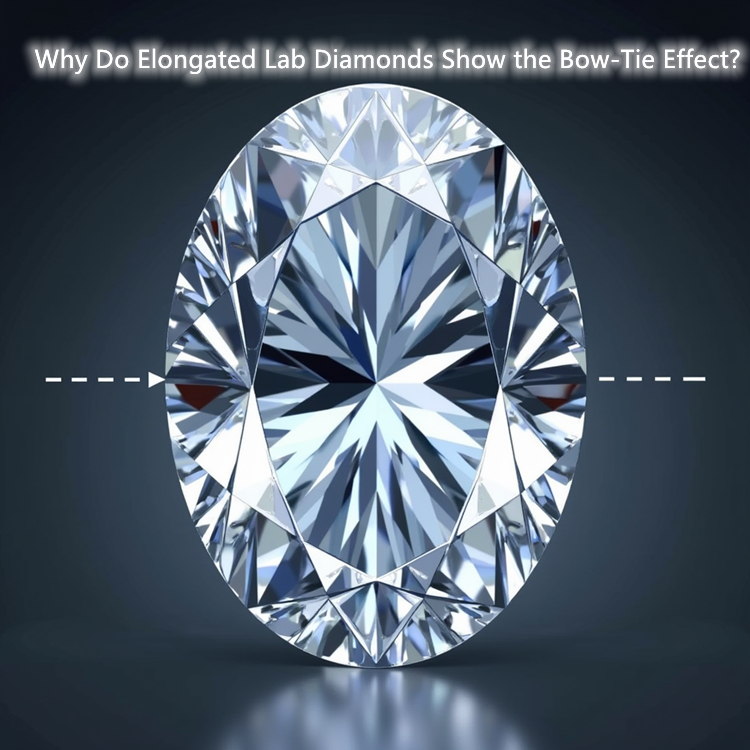
When shopping for lab-grown diamonds, you might notice something peculiar: certain oval, pear, or marquise-shaped diamonds display a dark shadow across their center that resembles a bow-tie. This is what the diamond industry calls the "bow-tie effect."
This phenomenon isn't a flaw or defect in the diamond, but rather a direct result of the stone's cutting geometry. What's even more confusing is that two diamonds with identical certificate parameters—same length-to-width ratio, same cut grade—can behave completely differently: one might show no bow-tie at all, while the other displays a pronounced dark shadow.
This article will dive deep into the optical principles behind the bow-tie effect, why it primarily occurs in elongated cuts, and how to make informed decisions when purchasing lab-grown diamonds.
What Is the Bow-Tie Effect?
The bow-tie effect refers to a dark or black area visible in certain fancy-cut diamonds when viewed from the table (the top of the diamond). This shadow typically spans the center of the stone, extending along its widest section, resembling a bow-tie or butterfly shape.
It's important to understand that the bow-tie effect is not an inclusion (impurity), nor will it be noted on certificates. It's an optical phenomenon determined by how light travels through the diamond's interior.
The severity of bow-ties varies dramatically. Some diamonds show only a very slight, barely visible bow-tie that's noticeable only at certain angles, while others display a prominent black area that significantly impacts the diamond's overall brilliance and beauty.
Why Does the Bow-Tie Effect Occur? Understanding the Optics
To understand the bow-tie effect, we need to grasp how diamonds handle light. A diamond's beauty comes from three optical properties: brightness, fire, and scintillation. All of these depend on how light refracts and reflects after entering the diamond.
In an ideally cut diamond, light enters through the table, reflects off the facets at the bottom (pavilion), and returns through the table to the observer's eye. This is what makes diamonds sparkle.
However, elongated cuts present inherent challenges due to their shape. The geometry of oval, pear, and marquise diamonds means that certain areas—particularly around the widest part of the stone—may have facet angles that cannot effectively reflect light.
When the facet angles in these areas are too shallow or too steep, light "leaks" out instead of reflecting back to the observer's eyes. These areas appear darker due to the lack of returning light, creating the bow-tie-shaped shadow.
Specifically, the issue primarily stems from the pavilion main facet angles (the angles at the diamond's bottom). When these angles don't harmonize with the elongated shape, they create zones of poor light performance in the diamond's center.
Which Diamond Shapes Are Most Prone to Bow-Ties?
The bow-tie effect appears almost exclusively in elongated fancy-cut diamonds. Let's explore the four most common shapes in detail:
1. Oval Cut
The oval cut lab diamond is currently one of the most popular fancy shapes, prized for its elegant appearance and finger-lengthening effect. However, ovals are also among the most prone to bow-tie effects.
Oval diamonds typically have length-to-width ratios between 1.30 and 1.50. Within this range, the pavilion facets at the diamond's center—its widest section—must be precisely cut to ensure proper light return. If the cutter makes the pavilion too deep to retain carat weight, or too shallow to enlarge the table, the bow-tie effect becomes pronounced.
In oval lab-grown diamonds, the bow-tie typically appears as a horizontal dark zone spanning the diamond's center. A mild bow-tie might be visible only under certain lighting conditions, but a severe one creates an obvious "dead zone" under any light.
Buying tip: When selecting oval diamonds, you must view actual photos or videos. Cut grades on certificates (when available) often don't accurately reflect bow-tie severity.
2. Pear Cut
Pear-shaped diamonds combine characteristics of round and marquise cuts, with one rounded end and one pointed end. This unique shape makes pears optically more complex.
The bow-tie effect in pear diamonds typically appears at the "shoulders"—the area transitioning from the widest section toward the point. This is because the pavilion facets in this region must handle the geometric transition from rounded to pointed.
Compared to ovals, pear-shaped bow-ties can be more asymmetrical. If the diamond's two sides aren't cut symmetrically, one side may display a more pronounced shadow than the other.
The ideal length-to-width ratio for pear diamonds typically ranges from 1.45 to 1.75. Overly elongated pears (ratios above 1.75) tend to have more severe bow-ties because the extreme shape makes light management more challenging.
Buying tip: Pear diamonds require special attention to symmetry. Check not only for bow-ties but also ensure the two side profiles match and the point is centered.
3. Marquise Cut
Marquise diamonds are football-shaped with points at both ends. This shape offers the largest table-to-carat ratio of all cuts, meaning it looks bigger for its weight. But this advantage comes at a cost: marquise cuts are the most prone to pronounced bow-tie effects.
The extreme elongation of marquise shapes (ideal ratios typically between 1.75 and 2.25) means the central zone is optically especially challenging. The pavilion facets in the middle section must be cut at very precise angles to avoid extensive light leakage.
In marquise diamonds, bow-ties often appear as a wide shadow band running through the entire center. Due to the shape's symmetry, when a bow-tie is present, it's usually very obvious and hard to ignore.
Buying tip: Marquise diamonds require extra caution. Since this shape is already less common, high-quality marquise lab-grown diamonds with minimal bow-ties may be limited in the market. Choose the one with the lightest bow-tie when possible.
4. Heart Cut
Heart-shaped diamonds are the most romantic cut but can also display bow-tie effects, though less commonly or prominently than the previous three shapes.
In heart diamonds, bow-ties typically appear below the "cleft" (the top indentation), along the widest section. Because heart diamonds have length-to-width ratios closer to 1:1 (ideal ratios between 0.90 and 1.10), they're less elongated than other shapes, so bow-tie effects are usually milder.
However, the complexity of the heart cut means cutting quality significantly impacts the final result. Poorly cut heart diamonds may have asymmetrical dark zones.
Buying tip: The primary consideration for heart diamonds should be overall shape symmetry and profile appeal. The bow-tie effect is relatively secondary but still worth checking.
Why Do Round Diamonds Rarely Show Bow-Ties?
In contrast, round brilliant cut diamonds almost never show bow-tie effects. This is due to the symmetrical geometry and standardized cutting proportions.
The 57 or 58 facets of a round diamond are arranged in perfect radial symmetry, meaning light entering from any direction is handled similarly. The industry has conducted centuries of research on ideal proportions for round cuts, with clear optimal ranges for parameters like table percentage, pavilion angle, and crown angle.
Elongated cuts lack this standardization advantage. Every oval, pear, or marquise is inherently unique because their length-to-width ratios and specific proportions can vary significantly. This variability makes it harder for cutters to consistently achieve optimal optical performance.
How to Evaluate Bow-Tie Effect in Lab-Grown Diamonds
Since certificates don't note bow-tie effects, how do you evaluate this factor when buying lab-grown diamonds?
1. Request Actual Photos and Videos
This is the most important step. Don't rely solely on certificate parameters or stock photos. Ask sellers for photos and 360-degree videos of the specific diamond under various lighting conditions.
High-quality videos should show the diamond in natural light and from various angles. Watch for persistent dark zones in the diamond's center.
2. Compare Multiple Diamonds
If possible, request to view several diamonds with similar specifications. Direct comparison makes differences in bow-tie effects more apparent.
3. Seek Professional Opinion
如果你不确定自己看到的暗影程度是否可以接受,可以向独立的宝石学家咨询意见。许多在线钻石零售商也提供专业咨询服务。
If you're unsure whether the darkness you see is acceptable, consult an independent gemologist. Messigems also offer professional consultation services.
4. Set Personal Acceptance Standards
Remember, almost all oval, pear, and marquise diamonds will have some degree of bow-tie effect. The key question isn't "is there a bow-tie," but rather "how severe is it" and "can I accept it."
A mild bow-tie might be invisible under most viewing conditions, appearing only under very bright direct light. This is usually acceptable. But if the bow-tie is obvious under normal indoor lighting and significantly impacts the diamond's overall brilliance, you should choose a different stone.
Is Bow-Tie Different in Lab-Grown vs. Natural Diamonds?
From an optical standpoint, there's no fundamental difference in bow-tie effects between lab-grown and natural diamonds. Both are determined by cutting geometry, independent of how the diamond was grown.
Additionally, because lab-grown diamond production allows better control over crystal growth, some manufacturers are beginning to focus on producing rough crystals better suited for specific cut shapes, which may further improve optical performance in elongated cuts in the future.
Finding Balance Between Beauty and Personal Preference
The bow-tie effect is an unavoidable optical characteristic of elongated diamond cuts, but this doesn't mean you should avoid oval, pear, or marquise diamonds. These shapes each have unique charm—the elegance of ovals, the uniqueness of pears, the drama of marquises—aesthetic values that are entirely worth careful selection.
The key is to be aware of the bow-tie effect, understand its causes, and make informed choices when purchasing. Don't rely solely on numbers on certificates—always view actual diamond photos and videos. Buyers willing to spend time comparing multiple diamonds will ultimately find that perfect gem that matches both their aesthetic preferences and delivers excellent optical performance.
In today's rapidly evolving lab-grown diamond market, consumers have unprecedented freedom of choice. Use this advantage, don't rush your decision, and wait until you find a diamond that truly captivates you—one that sparkles in your hand rather than being shrouded in shadow.