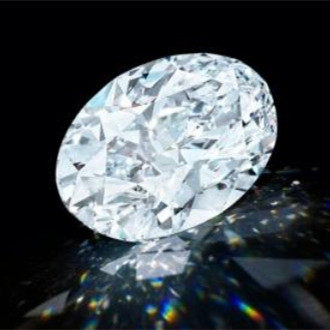
Recently, we have seen some traders offering Moissanite diamond jewellery, claiming that Moissanite diamonds are an affordable alternative to natural diamonds, with essentially the same effect and meaning.
The effect and meaning are essentially the same, but at less than a tenth of the price of a natural diamond. This is why many people who do not know the difference between a Moissanite diamond and a natural diamond

Many people who do not know the difference between a moissanite and a natural diamond are confused and do not know whether to believe this claim or not. Here we share with you the difference between a moissanite diamond and a diamond.
Before we look at the difference between a Moissanite diamond and a diamond, let's first understand the concept of a Moissanite diamond. Moissanite diamonds are also known as "moissanite"

The natural moissanite was discovered in 1904 by the French chemist Henri Moissan in the Arizona meteorite crater.
The mineral was discovered in the Arizona meteorite crater in 1904 by the French chemist Henri Moissan, and the new stone was named internationally after Moissan. In reality, however, natural moissanite
Moissanite is mostly dull green and black, not at all suitable for jewellery, and it is extremely scarce. Nowadays, moissanite is sold as
The "moissanite diamonds" that are now available on the market are actually laboratory developed, that is, artificial moissanites.

Natural moissanite found in north-eastern Israel
The mineral name for natural diamonds is diamond, which is a pure carbon structure, while the mineral name for moissanite diamonds is silicon carbide.
In essence, they are two completely different substances, so the main difference between moissanite and diamond is the difference in physical properties. The difference between a moissanite diamond and a diamond can be made by
The following points can be used to distinguish between moissanite diamonds and natural diamonds.

The specific gravity of a natural diamond is 3.52, while that of a moissanite is 3.22. For unset materials, it is easy to distinguish between the two with a methyl iodide specific gravity solution.
It is easy to distinguish the two with methyl iodide.
2. The hardness of natural diamonds is 10, the hardest known mineral in nature, while the hardness of moissanite diamonds is 9.25.
The hardness of a moissanite diamond is less than that of a diamond, so a scratch test with a diamond hardness tester on the surface of a moissanite will leave a scratch, while a scratch tester
The hardness of a moissanite diamond is less than that of a diamond.
Natural diamond Enigma landed from space
3. The refractive index and dispersion values are different: the refractive index of a moissanite diamond is 2.65 and the dispersion value of a fire colour is 0.104; whereas the refractive index of a natural diamond is 2.417 and the dispersion value of a fire colour is 0.104.

The refractive index of a natural diamond is 2.417 and the dispersion value of the fire colour is 0.044.
Moissanite has more colours. Moissanite has been described as being like a beautiful woman in heavy make-up, whereas natural diamonds are more like a cool and noble nymph. Also
Moissanite diamonds have a biaxial luminous character, with reflective overtones when viewed from the table top, a feature that is completely different from the crown reflection of a mono-refractive diamond.
This feature is completely different from the reflection of the crown of a mono-refractive diamond.
4. Different conductivity: according to the GIA report, 80% of moissanite is an electrical conductor, whereas the common white and light yellow natural diamonds are non-conductive.
A 102.39 carat natural diamond - Maiko Star
5. The polished lines are different: the girdle polish lines of moissanite diamonds are parallel to each other, which is completely different from natural diamonds. And because of the different orientations of natural diamonds, the polishing direction has to be constantly adjusted during the polishing process, whereas Moissanite diamonds can be polished in the same direction. This is particularly true for
This is particularly noticeable between adjacent facets.
The difference between a Lab Moissanite and a diamond is also one of practical and emotional value.
Natural diamonds are rare, formed under extremely demanding conditions, and as they continue to be mined, they will become less and less available and their value will and therefore have a high value retention. And since ancient times natural diamonds have been a symbol of power, status and wealth.
At the same time, because of their beauty and rarity, natural diamonds are also a symbol of love and fidelity, representing eternal and unbreakable love. Through the passage of time baptism of time, natural diamonds have long been more than simple jewellery in people's hearts, but more like a sincere way of expressing their feelings.
Natural diamond rough
Although Vvs Loose Moissanite are close to natural diamonds in appearance, they do not have the value and heritage significance of natural diamonds. For jewellery purposes
Super white moissanite are synthetic and can theoretically be produced in any quantity desired, so they are not rare.
This is one of the reasons why Moissanite diamonds are not very expensive. They also do not retain their value and few people are willing to pay for them to be recycled.
The above is a brief introduction to the difference between Moissanite and natural diamonds.
For more information on the differences between moissanite and natural diamonds, please visit the Only Natural Diamonds website.